

The Vessel Wife Character
Emotional Laundering and the Man in power.

Every other “Best actress category”, we are fed a specific kind of bait: “The Wife Of.” Critics praise these films for finally giving a voice to the women in the shadows, but if you look closer, it’s a trap. These films aren’t actually interested in the woman’s story; they are using her as a shock absorber for the male ego. They use her to make approachable leaders out of statues.
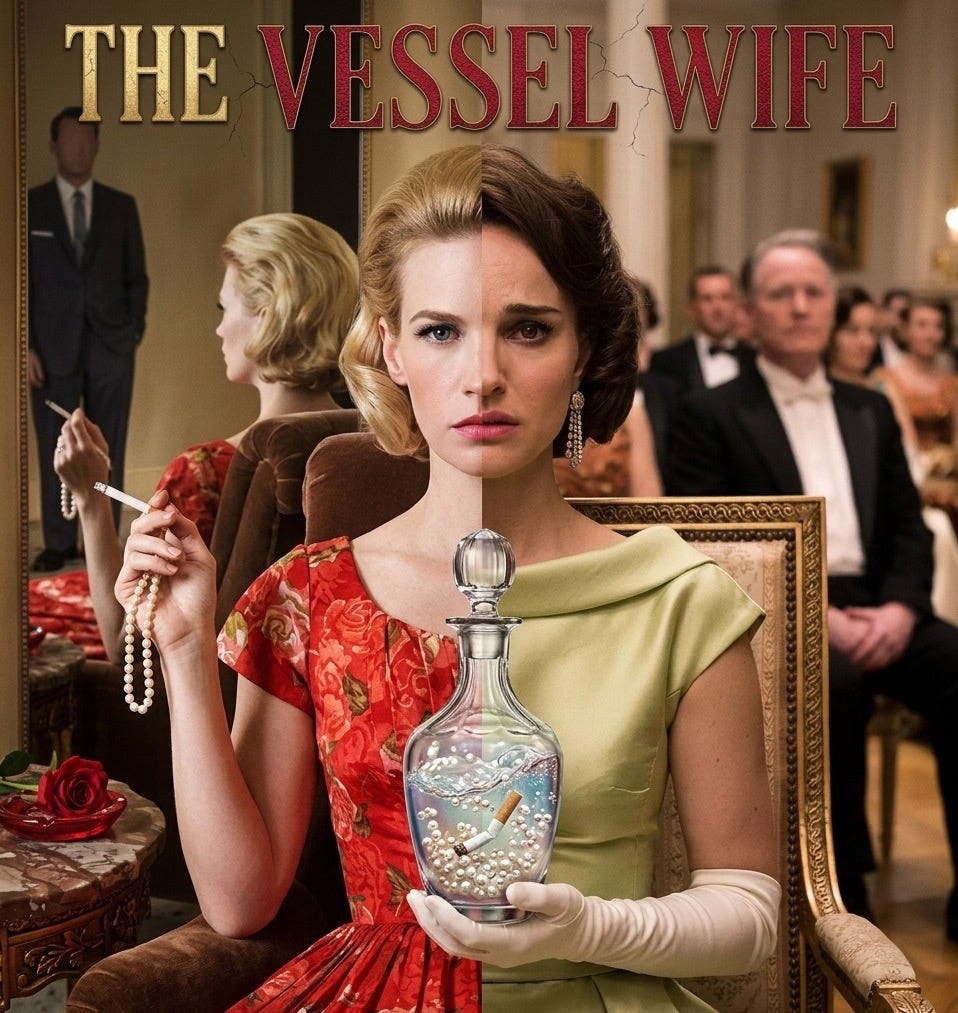
We’ve assigned women a role they never asked for: the Vessel Wife.
A Vessel Wife is a character who exists to process the trauma, interiority, and emotional wreckage that the Great Man is too busy (or too masculine) to acknowledge. She is a surrogate for the audience’s empathy because the man is treated as a monument. We don’t see the King cry; we see the Queen watching the King cry.

The Side-Path as a Narrative Shield
Why focus on the wife? Because it’s a convenient shield. By taking the side-path.
The Legend Stays Untouchable: The man remains the strong, stoic leader. He doesn’t have to show weakness because she’s doing it for him.
Outsourced Emotional Labor: She does the “trauma journey” so he can keep doing the “power journey.”
The Collateral Effect: We see his flaws reflected in her suffering. This allows the filmmaker to critique him without ever having to actually deconstruct his macho facade. It’s a patriarchy cosplay incarnated by the catholic aunties that cries, “But what about the wifeeee?” while keeping the man on his pedestal.
The Vessel Short-List
Priscilla (Sofia Coppola): The isolation of being an accessory. A woman curated to fit a superstar’s domestic fantasy.
The Last Station: Sofya Tolstoy fighting the messy, grounded battles while Leo plays the “spiritual icon.”
The Iron Lady: Even when the woman is the power, the film uses the supportive shadow (Denis) to humanize the coldness of the State.
The Wife: The most meta version. Decades of funneling female genius into a husband’s career just to keep his public image intact.
George & Tammy: The PhD-level masterclass in the Vessel Wife as Emotional Janitor. Tammy Wynette acts as the emotional recipient for George Jones’s addiction.
Mad Men (TV): Betty Draper as the doctorado in processing the neurosis of the 1960s while Don Draper merely processes whisky. She’s not the main character but definitely a vessel one.
The Eyes of Tammy Faye: The Spiritual Shock-Absorber for a fraudulent religious empire. (I give it a point, she was kind of a gay icon).
The Exception: The Larraín Gaze
If there is anyone doing it right, it’s Pablo Larraín. With Jackie, Spencer, and now Maria, Larraín has perfected the Anti-Biopic. He isn’t interested in a Wikipedia timeline; he is interested in the horror of being an icon. Larraín treats the Palace and the White House as haunted houses. In Spencer, Sandringham is cold, the heating is broken, and the ghosts of Anne Boleyn haunt the halls is transformed from a royal retreat into a gothic prison in a beautiful subtile art direction.
Larraín uses the side-path for subversion, not protection:
Erasure of the Man: In Spencer, Prince Charles is a supporting character in his own life. He is cold and cryptic because Diana is doing enough emoting for the entire family.
The Costume as a Cage: Jackie’s pink suit and Diana’s gowns are uniforms. Larraín shows that if the wife-of stops her performance, the man in charge loses his legitimacy.
The Canary in the Coal Mine: Diana’s messiness (her bulimia, her rebellion) is the only human thing in a system of taxidermied people. To be human in that system is a malfunction.
The Local Production Trap
And then, there is the other side of the coin. I stumbled across a story that I cannot believe Amazon dared to upload to its catalog: Sara: Amor y Revolución. This is the very antithesis of Larraín. It is a monograph cinema the kind of educational propagandistic subtile story for a school project. It is emotional laundering at its most amateur.
Because Francisco I. Madero is seen as a distant, abstract political figure, the director uses the wife to say: -Look, he was a good man because this saintly woman loved him.-. The supportive shadow fantasy is a patriarchal fantasy disguised as a feminist recovery of history. Is almost comical and flat as any mexican telenovela. We need to stop accepting wife-as-pr-department filmmaking and start calling it what it is: a decorative layer of paint on a very old, very masculine wall.
Sara doesn’t give the woman a voice; it gives her a bad script written by the actual anti feminist narrative that silenced her. It’s an “estampita”(a prayer souvenir card) meant to polish the bronze of a statue that was already crumbling.
The story is not about her, it’s about him. This is what I call: the vessel wife character.
Historically, Madero’s political naivety actually led to one of the bloodiest periods in Mexican history (La decena trágica). Using Sara Pérez Romero story to sanitize Madero’s image isn’t just bad filmmaking simply is a way to keep the myth of the man in power. Fortunately, today’s audiences are no longer buying the lie. We’ve developed an intolerance for hollow vessels, and for that, we can thank the deconstructive gazes of Larraín and Gerwig.
#micdrop🎤🔥
The Catalogue Abism: Many countries are increasingly pressuring streamers to host a certain percentage of local content. To meet these taxes quickly and cheaply, platforms often buy packages of independent or state-sponsored films. They don't care if the film is a masterpiece. A profound negligence toward Spanish-speaking audiences. Because it was part of a distribution deal for "independent" (read: institutional) cinema rather than a Prime Original, there was zero quality control, was uploaded for its zip code.